EcoBoost Tuner Buyer's Guide — Handheld Flash, Custom Tunes, and What a Tune Actually Changes
A plain-English reference for tuning a Ford EcoBoost: how handheld flash tuners work, VIN-locking and unmarrying, off-the-shelf vs custom calibrations, octane maps, towing tunes, the supporting hardware a tune demands, and the warranty and emissions realities nobody puts on the box.
Parts for This Job at a Glance

Restoring boost or chasing more power

Ford EcoBoost owners

Owners wanting more power and monitoring
Restoring boost or chasing more power
| # | Product | Owner Reviews | Availability | Best For | |
|---|---|---|---|---|---|
| 1 | 159 | $125.98 In Stock at Amazon | Restoring boost or chasing more power | Buy on Amazon
Prime Eligible
| |
| 2 | 812 | $55.19 In Stock at Amazon | Ford EcoBoost owners | Buy on Amazon
Prime Eligible
| |
| 3 | 358 | $63.59 In Stock at Amazon | Owners wanting more power and monitoring | ||
| 4 | 161 | $56.79 In Stock at Amazon | Restoring boost or chasing more power | Buy on Amazon
Prime Eligible
|
Tuning is the most-searched EcoBoost upgrade and the one with the most confusing shopping experience. The boxes all promise horsepower, the forums argue about brands, and almost nobody explains the two things that actually determine whether the purchase works out: what the calibration is assuming about your truck, and whether the device you’re buying is legally and technically able to program it.
This page is the reference version. No brand scoreboard, no power claims we can’t stand behind — just how EcoBoost tuning works, what to buy for which goal, and the hardware a tune quietly depends on. If you’re not sure which engine and generation you have, start with the EcoBoost generations and fitment reference — tune files are generation-specific and ordering the wrong one is the most common wasted purchase on this platform.
What a Tune Actually Changes
A tuner does not add hardware. It rewrites the calibration tables inside the powertrain control module — the lookup tables the PCM consults thousands of times a second. On a turbocharged, direct-injected engine, the meaningful ones are:
- Target boost pressure. The factory turbochargers are capable of more than the stock calibration asks of them. Raising the wastegate duty targets is where most of the added torque comes from.
- Ignition timing advance. More timing extracts more work from the same charge — right up until it doesn’t, which is why the fuel requirement is not a suggestion.
- Fuel delivery. Injector pulse width and rail pressure targets have to keep up with the added air, and the air-fuel ratio under load is normally enriched for cylinder cooling.
- Throttle mapping. How far the electronic throttle opens for a given pedal position. This changes nothing about peak output but is responsible for a large share of how much quicker a tuned truck feels.
- Transmission behavior. Shift points, shift firmness, and torque-converter lockup. On the Gen1 six-speed and the Gen2-onward ten-speed alike, this is often the change owners notice most in daily driving.
Everything on that list is the engine being asked to work harder with the same parts. That framing explains every rule that follows.
The Two Ways to Get a Tune Into the Truck
Handheld flash devices
The mainstream path. A handheld programmer plugs into the OBD-II port under the dash, reads and stores your factory calibration, and writes a new one. The device carries a set of pre-built maps, and most also act as a gauge display and a code reader. For a stock-to-lightly-modified truck this is the whole product.
Two things about handhelds catch people out:
They VIN-lock — “marrying” — to the first truck they program. The device writes your VIN to itself and will not program a second vehicle until it has been used to return the original truck to its stock calibration and then released. That process is variously called unmarrying, unlocking, or returning to stock. It is deliberate anti-piracy design, and it is permanent enough that it defines the used market.
Custom tunes load onto the same hardware. Buying a handheld does not commit you to its canned maps forever. Most tuning shops deliver custom calibration files that load onto the common handheld platforms, so the device becomes the delivery mechanism for a tune built specifically for your truck later on.
PC-based tuning interfaces
The enthusiast and professional path: an interface cable plus PC software that gives direct access to the calibration tables and to full datalogging. Licensing on these platforms is typically per-vehicle — you buy credits and apply them to a VIN — so the hardware and the right to tune your specific truck are separate purchases. This is the correct tool if you intend to develop your own calibration, log seriously, or tune more than one vehicle over time. It is overkill if you want a torque bump and firmer shifts.
Off-the-Shelf vs Custom — the Honest Split
| Off-the-shelf (canned) | Custom / mail-order | |
|---|---|---|
| Best for | Stock or bolt-on truck | Turbos, big intercooler, E-blends, altitude, heavy towing |
| Built around | A representative stock truck | Your VIN, your mods, your fuel, your datalogs |
| Turnaround | Minutes, in your driveway | Days, with datalog revisions |
| Support | Documentation and a help line | A named tuner who revises the file |
| Risk if you’re honest about your setup | Low | Low |
| Risk if you’re not | The map assumes hardware you don’t have | The tuner corrects for what you told them |
The dividing line isn’t power level, it’s whether a generic map can know enough about your truck. Stock airbox, stock exhaust, stock intercooler, 93 octane available: a canned map knows everything it needs to. Upgraded turbochargers or a fuel habit the map has never seen: it doesn’t, and no amount of paying more for a canned tune fixes that.
Octane Maps: the Rule Nobody Should Bend
Tunes ship as a family of maps by fuel — commonly an 87-octane economy or towing map, a 91, and a 93. Some tuners add E-blend maps for owners running ethanol mixes.
Run the fuel the map was built for, every single time. The higher-octane map’s extra timing exists because the fuel resists detonation. Put 87 in a truck running a 93 map and you are relying on the knock sensors to pull timing fast enough to save the engine — which they usually do, and which is not a strategy.
Two practical consequences:
- Keep a conservative map loaded on the device. If your area’s premium supply is unreliable, or you’re about to tow across a state where you can’t be picky, reflash down before the trip rather than after the knock.
- E-blends are a commitment, not a setting. Running an ethanol map means mixing consistently and knowing your actual blend. Without flex-fuel content sensing, the calibration is trusting a number you’re maintaining by hand at every fill-up.
The Supporting Hardware a Tune Depends On
A tune raises cylinder pressure and charge temperature. Three systems feel that immediately, and all three are cheap next to the engine.
Ignition — the first thing to give up
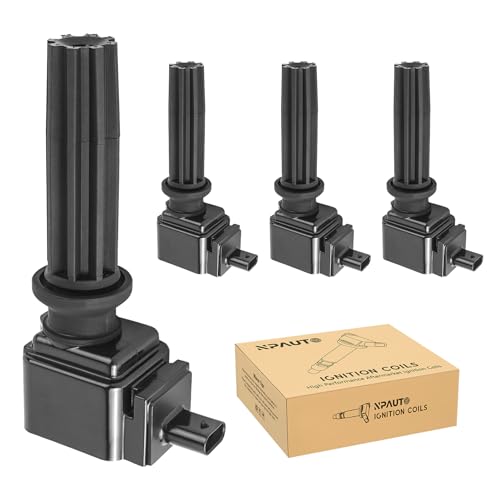
This is the most common tuning complaint and it is almost always the same story: a truck that ran fine at stock boost develops a stumble or a flashing check-engine light under a hard pull after tuning. Higher cylinder pressure makes the spark harder to establish across the plug gap, so a marginal plug or a tired coil that was invisible at factory boost becomes an audible misfire. Fresh plugs — gapped down for boost, not left at the wide factory gap — and healthy coils are effectively part of the tune. The ignition coils and spark plugs guide covers the diagnosis and the correct gapping in detail, and a full six-cylinder coil-and-iridium-plug set is the tidy way to do it in one pass on a 3.5. Four-cylinder 2.0 and 2.3 owners want the matching UF670 coil set instead.
Charge cooling — the ceiling on a tuned truck
More boost means hotter intake air, and hot air is what forces the calibration to pull timing to stay safe. On a stock intercooler, a tuned EcoBoost will make its best numbers on the first pull and progressively less on every pull after — that’s heat soak, not a bad tune. This is why the intercooler is the natural second purchase on a tuned truck rather than a bigger turbo; see the intercooler and charge-pipe guide for what actually improves and what the charge pipes have to do with it.
Breathing and crankcase management
A clean, high-flow air filter is the low-effort half. The more important half on a direct-injected engine is keeping oil vapor out of the intake tract: nothing washes the back of the intake valves on the early direct-injection-only engines, and a tune that has you in boost more often is putting more oil mist through the crankcase ventilation system. An oil catch can is the standard answer — the catch can guide explains what it does and doesn’t solve.
Towing Tunes Deserve Their Own Paragraph
If the truck’s job is pulling, the peak-horsepower map is the wrong purchase. A towing calibration is optimizing different things: low-end and mid-range torque where a loaded truck actually lives, earlier and more aggressive torque-converter lockup to keep heat out of the transmission, revised shift scheduling so the truck stops hunting between gears on a grade, and often a fan and thermal strategy tuned for sustained load. On a work truck that is a bigger real-world improvement than a peak number you’ll see for four seconds at a time. Most tuners include a tow map in the same package — use it.
One related item: if you’ve changed tire size, correct the speedometer calibration. Most tuners can write the correct tire size and axle ratio to the PCM, which fixes the speedometer, the odometer, and the shift scheduling that reads vehicle speed. The wheel and tire fitment guide covers what sizes actually fit before you get to that step.
Buying a Used Tuner Without Getting Burned
The used market for handheld tuners is large, and it is the one place where a cheap purchase can be worth exactly zero dollars. A five-point check:
- Confirm it is unmarried. Not “I think so.” A device still locked to a previous VIN cannot program your truck. Ask the seller to state plainly that the unit was returned to stock on the original vehicle and released.
- Confirm generation coverage. Tuner support is year-and-engine specific, and a device that covered a Gen1 3.5 may not cover a Gen2 truck without a firmware update — or at all.
- Ask about firmware updates. Some devices need a manufacturer account and a current subscription or update to see newer vehicles.
- Check what maps are on it. A used device sometimes arrives with the previous owner’s custom file loaded — which is built for their truck’s hardware and fuel, and should not be flashed to yours.
- Prefer sellers who show the device booting. A photo of the unit powered up with no VIN listed is worth more than a paragraph of description.
That’s a market eBay Motors serves far better than a new-parts channel does, which is why the rails on this page point there for the tuners themselves. Used and unmarried handhelds, PC interface hardware, and take-off intercoolers from owners who upgraded all move there constantly.
Where the Tune Sits in a Build Order
For most owners the sensible sequence is:
- Get maintenance current — oil, plugs, coils, air filter, no pending codes.
- Tune. The largest gain per dollar on the platform, and it’s reversible.
- Charge cooling — the upgrade that lets the tune keep its power on the second and third pull.
- Crankcase management and breathing — protect the engine you just asked more of.
- Exhaust, then turbos — only after the above, and with the calibration revised for them.
Notice that the tune comes before the hardware, not after. That ordering is deliberate: it’s the change that makes the biggest difference on an otherwise stock truck, it tells you whether you actually want more, and it’s the one purchase you can undo with a reflash if the answer is no. For the full picture on where each of those steps lands, the common EcoBoost problems by generation page maps the failure modes each stage of a build tends to expose, and the best EcoBoost bolt-ons list covers the hardware side in order.
The Part That Isn’t Fun
Two realities the marketing copy skips, stated plainly:
Warranty. A tune does not automatically void a Ford warranty, but modern PCMs log flash events, and returning to stock does not necessarily erase the evidence. A turbo or long-block claim on a truck that has been tuned is a claim a dealer can reasonably contest. If the warranty matters more than the power, don’t tune — that’s a legitimate choice, not a cop-out.
Emissions. A calibration that alters emissions-related parameters needs a CARB Executive Order number to be street legal in California, and many performance tunes don’t carry one. Other states vary from no testing at all to OBD-II readiness checks a tune can fail. And a tune sold to disable or mask emissions equipment isn’t a legal street product in the US regardless of what your local inspection looks like. Know which category your purchase falls into before you buy, not after.
None of that makes tuning a bad idea. It makes it a decision with terms — and an EcoBoost owner who buys with those terms in front of them almost always ends up happy with the result.
Shopping used or OEM? Try eBay Motors
Live listings for the parts covered in this guide — prices set by the seller.
Handheld EcoBoost tuners — selling now
LIVEReal-time eBay auctions · bids shown are current · tap a card to bid on eBay
Browse every live “ford f-150 ecoboost tuner programmer handheld” listing on eBay →
Recommended Parts for This Guide
Set of 6 Ignition Coil Pack Iridium Spark Plug 3.5 EcoBoost V6 Compatible with Ford F150 F-150 Flex Taurus Explorer Lincoln MKS MKT 2011 2012 2013 2014 2015 2016 2017 3.5L Turbo for DG549 SP534
159 owner reviews
Set of 6 Ignition Coil Pack Iridium Spark Plug 3.5 EcoBoost V6 Compatible with Ford F150 F-150 Flex Taurus Explorer Lincoln MKS MKT 2011 2012 2013 2014 2015 2016 2017 3.5L Turbo for DG549 SP534. Turbocharger hardware for the 2.7 and 3.5 EcoBoost — restore stock boost or step up to a billet-wheel upgrade turbo for more top-end power.
- Restores or adds boost
- Drop-in & upgrade options
K&N High-Flow Original Lifetime Engine Air Filter: Increase Power: Premium, Washable: Compatible with 2015-2023 FORD: Mustang, Mustang GT, 33-5029
812 owner reviews
K&N High-Flow Original Lifetime Engine Air Filter: Increase Power: Premium, Washable: Compatible with 2015-2023 FORD: Mustang, Mustang GT, 33-5029. A quality upgrade or replacement part for your Ford EcoBoost.
- Fits Ford EcoBoost
- Quality build
EVIL ENERGY Oil Catch Can, Air Oil Separator Compatible with 2011-2025 F-150 5.0L 2017-2023 Raptor 2018-2021 Expedition 3OZ
358 owner reviews
EVIL ENERGY Oil Catch Can, Air Oil Separator Compatible with 2011-2025 F-150 5.0L 2017-2023 Raptor 2018-2021 Expedition 3OZ. Bolt-on performance for the EcoBoost — catch cans, valves, gauges, and pulleys that add power and monitoring.
- Adds power & monitoring
- Protects the DI intake
Ignition Coil Pack fit for 2.0T 2.3T Turbo Ford Lincoln (13-19), UF670 | for 2013 2014 2015 2016 2017 2018 2019 Ford Escape, Focus, Fusion, Explorer, Edge Mustang Taurus, Lincoln MKZ MKT MKC, Eco
161 owner reviews
Ignition Coil Pack Set of 4 fit for 2.0 2.3 Turbo 2013 2014 2015 2016 2017 2018 2019 Ford Escape, Focus, Fusion, Explorer, Edge Mustang Taurus, Lincoln MKZ MKT MKC, Ecoboost 2.0T 2.3T, UF670. Turbocharger hardware for the 2.7 and 3.5 EcoBoost — restore stock boost or step up to a billet-wheel upgrade turbo for more top-end power.
- Restores or adds boost
- Drop-in & upgrade options